Table of Contents

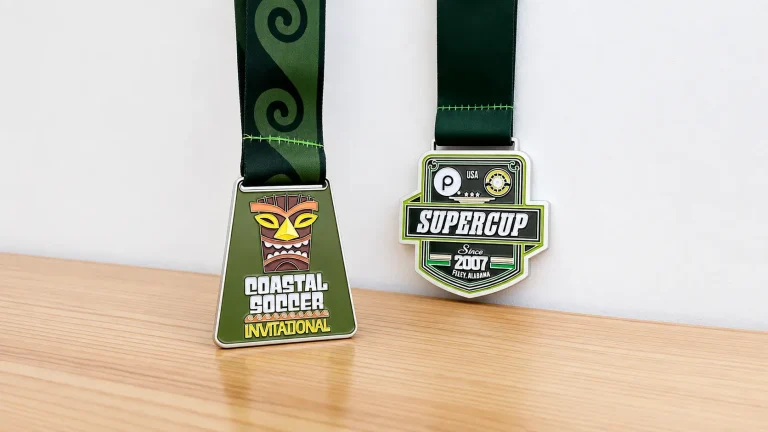
Whether it’s a road race, marathon, sports league, school competition, or company event, custom medals are a great way to recognize both top performers and everyone who takes part.
But when an event includes first, second, and third place along with finisher or participation awards, how do you make each one easy to tell apart?
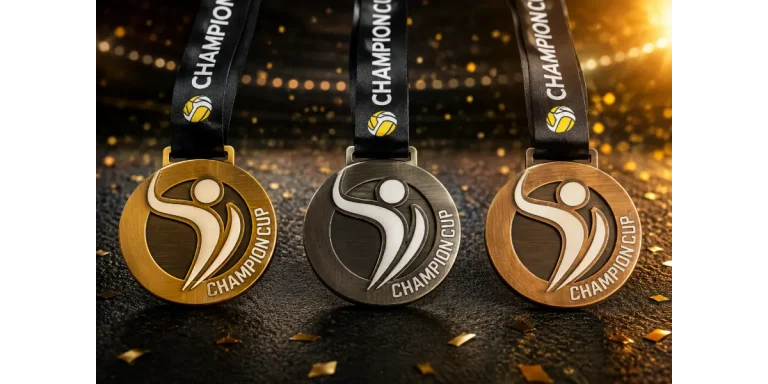
A common approach is to use gold, silver, and bronze finishes for the top three places. For finishers, participants, or commemorative pieces, black nickel, antique silver, or another finish can help create a clear visual difference.
In this guide, we’ll look at how to design awards for each placement and how to choose the right style for different types of participants.
What Are Gold, Silver, and Bronze Medals Made Of?

A lot of people assume gold, silver, and bronze medals are made from the metals they’re named after, but that’s usually not the case. Even modern Olympic gold medals aren’t solid gold. They’re made mostly from silver that’s at least 92.5% pure, then coated with 6 grams of pure gold. Bronze medals are typically made from a copper-based alloy.
For commercial events and custom medals, the material you choose usually comes down to the design, production method, and budget.
Zinc alloy is the most common option and the one most of our customers choose. It works especially well for detailed shapes, raised designs, and cutouts.
Iron costs less and works well for simpler designs or projects with a tighter budget.
Copper or brass costs more, but it feels heavier in the hand and gives the finished piece a more premium metal feel.
How to Design Medals for Different Placements

1. The Top Three Can Share One Mold
A common way to do this is to use the same mold for first, second, and third place, then change the plating:
- First place: Polished Gold
- Second place: Polished Silver
- Third place: Copper or Antique Bronze
This keeps the whole set consistent while still making each placement easy to tell apart.
If changing the plating alone doesn’t feel like enough, you can also switch up the enamel colors. For example, red for first, blue for second, and green for third, with matching ribbon colors.
You can also add 1st, 2nd, 3rd, names, numbers, or dates with laser engraving without changing the original mold.
2. Finisher Awards Can Use the Same Base Design Too

If your finisher medals use the same mold as the top-three awards, you can still make them feel different through the finish.
For example, while first, second, and third place use gold, silver, and bronze, the finisher version could use black nickel, antique silver, or another metal finish. You can also keep more of the metal exposed, use fewer enamel colors, and pair it with an event-themed ribbon that includes FINISHER.
That way, you can give the finisher medal its own look without making a new mold, while also keeping production costs under control.
When Do You Need a New Mold?
If the medal’s shape, size, thickness, raised details, or fixed design elements change, you’ll usually need a new mold.
Think of the mold like a stamp. If 2026 is built into the design as raised or recessed text, that year is fixed into the mold.
So when 2027 comes around, even if everything else stays exactly the same, changing 2026 to 2027 would still require a new mold.
How Many of Each Medal Should You Order?
It helps to calculate placement medals and finisher medals separately, since they’re based on different numbers.
Placement Medals
For gold, silver, and bronze, start with the number of events and divisions.
Formula:
Number of events × number of gender/age divisions × 3
For example, if you have 2 events and each one has a men’s and women’s division:
2 × 2 × 3 = 12 medals
That means 4 gold, 4 silver, and 4 bronze.
It’s also a good idea to add an extra 2%–5% for ties, damaged pieces, or keepsakes for organizers and sponsors.
Finisher Medals
For finisher medals, ordering based on total registrations alone can leave you with too many, since not everyone who signs up will show up or finish.
A simple way to estimate the quantity is:
Registration cap × expected attendance rate × expected finish rate + 5% extra
For example, if your registration cap is 1,000, you expect 90% of runners to show up, and 95% of those runners to finish:
1,000 × 90% × 95% = 855
Add a 5% buffer, and you’d want to order about 898–900 medals.
That small extra amount gives you some room for last-minute registrations, counting errors, or damaged medals without overordering by too much.

Choose a Reliable Medal Supplier
Your medal supplier is part of the event planning process too. A great design doesn’t help much if the medals don’t arrive before event day.
At VeperPins, production can be completed in as little as 5 days, and there’s no minimum order quantity. Whether you’re planning a small local competition or a large event, you can order based on what you actually need.
Planning your next event? Take a look around our website — we’d be happy to help you get the medals ready and keep things on track.