Table of Contents
When creating custom enamel pins, choosing the right size is one of the most important decisions. The most common range is 1–1.25 inches, with 1.25 inches being the most popular choice, followed by 1 inch and 1.5 inches.
Although custom pins can be made in a wide range of sizes, not every option is suitable for everyday wear. A design that is too large may feel heavy or look out of place, while one that is too small may lose fine details, small text, or important visual elements.
In this guide, we’ll explain standard lapel pin sizes and help you choose the right option based on your artwork, usage, and budget.
If you are new to custom pins, beginner’s guide can also help you understand the basics before choosing your ideal size.
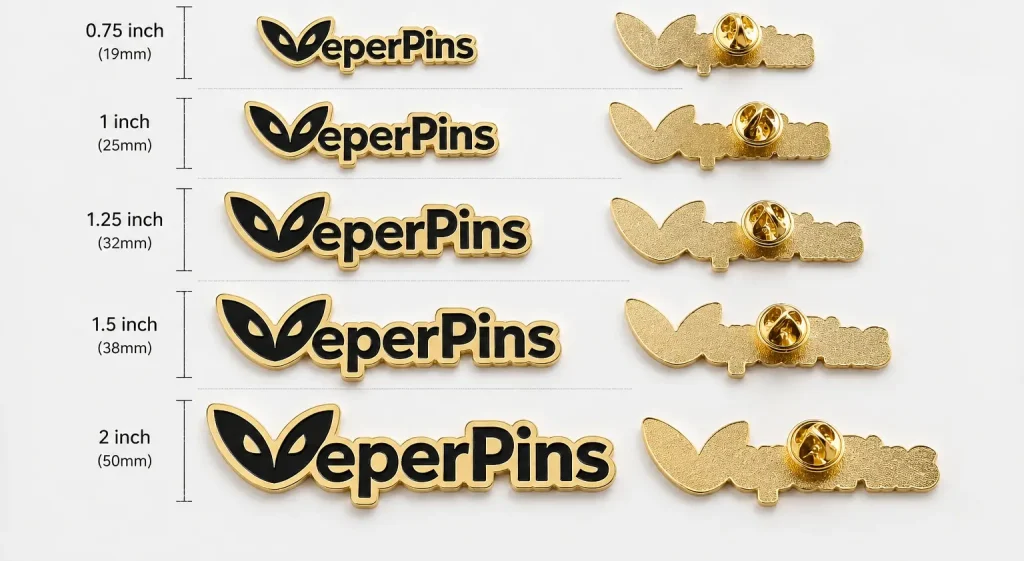
Lapel Pin Size Chart: Small, Medium, and Large Sizes Explained
Before designing your custom lapel pins, it’s helpful to review the common size ranges below. We’ve grouped them into small, medium, and large categories to help you quickly understand your options.
Small Pins (0.75″ and below)
First, it’s important to understand that a 0.5″ (12.7 mm) pin is roughly the diameter of a Barrett M82 bullet. At this size, only very simple designs are possible—usually without logos or text, and even enamel colors may be limited. As a result, this size is rarely chosen.
However, a 0.75″ (19.05 mm) pin allows for slightly more flexibility. It’s about the size of a United States one-cent coin. Simple designs can work at this size, but it’s not suitable for designs with more than three colors.
Medium Sizes (1″–1.25″)
Pins between 1 inch (25.4 mm) and 1.25 inches (31.75 mm) are roughly the size of a shirt button. This is one of the most popular and commonly ordered size ranges.
These sizes are highly versatile in real-world use. Whether you have a simple logo or a design with moderate detail, they can present clearly. Compared to smaller sizes, they offer better readability for text and finer details, while still remaining subtle and comfortable for everyday wear.
If you’re unsure which size to choose, 1″–1.25″ is generally the safest option, balancing appearance and practicality.
Large Sizes (1.5″–2.25″)
Pins in the 1.5″–2.25″ (38–57 mm) range are approximately the size of an egg. Larger pins are ideal for showcasing complex designs and rich details, offering more space for intricate artwork and customization. Visually, they stand out much more.
However, keep in mind that the larger the pin, the more noticeable it becomes when worn. This makes it less suitable for everyday or formal occasions.
Typically, larger pins are better suited for:
- Sporting events
- Commemorative occasions
- Film, entertainment, or pop culture designs
When we talk about “larger sizes,” it doesn’t mean bigger is always better—it depends on the wearing scenario.
For example, if you choose a 2.25″ pin, manufacturers will often double-check your requirements. In practice, very few people wear pins this large on suits, shirts, or daily outfits, especially for corporate or formal purposes.
Oversized Pins (2.5″ and above)
Pins 2.5 inches (63.5 mm) and above fall into the oversized category. These offer a strong visual impact and are ideal for displaying highly detailed artwork, textures, and advanced customization.
This size is rarely used for corporate events. Instead, it’s more commonly chosen by artists to showcase their creations, or by collectors who appreciate bold and unique designs.
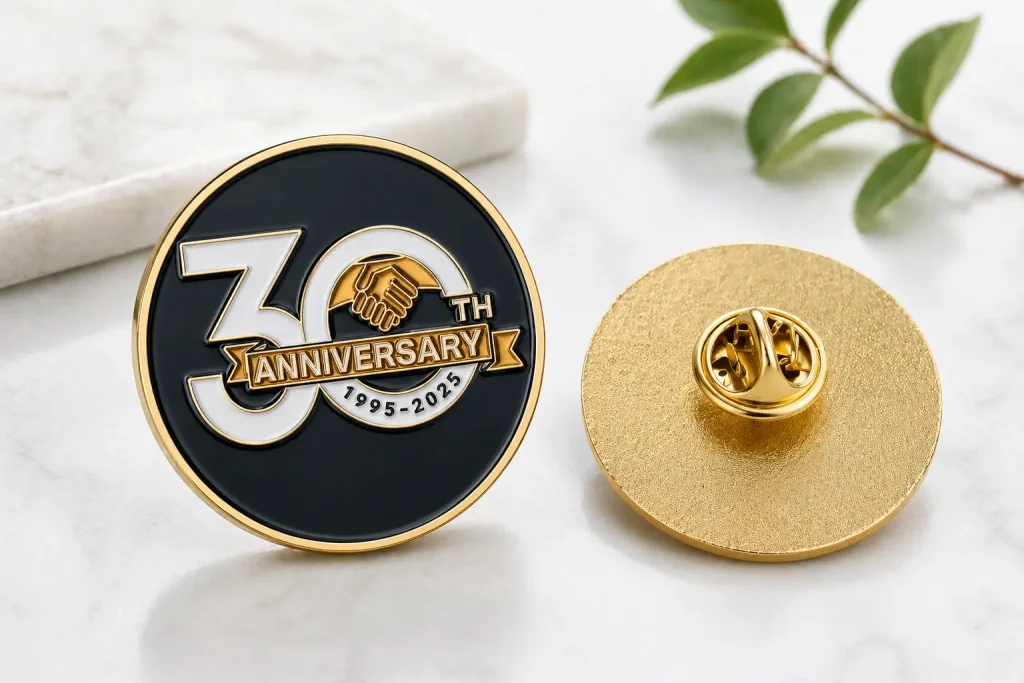
What Size Lapel Pin Should You Choose for Your Design?
After reading the size overview above, you should already have a basic understanding of different lapel pin sizes. But when you are ready to design your own custom enamel pins, the more important question is:
Which size is the best fit for your design and use case?
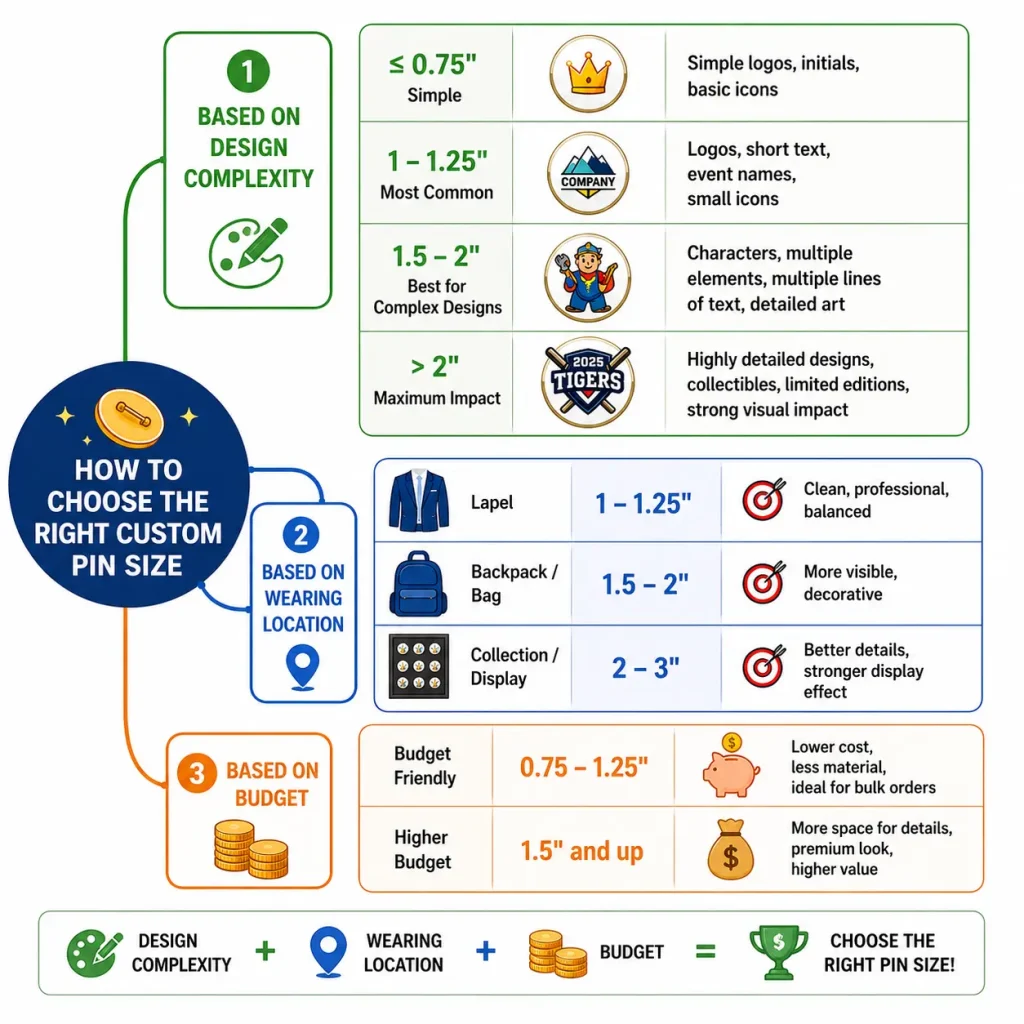
Below, we will share some practical size recommendations based on design complexity, wearing position, and budget to help you choose the most suitable option.
1. Choose Based on Design Complexity
Design complexity is one of the most important factors when choosing the right lapel pin size. The more details your artwork includes, the more space it needs to appear clear and balanced.
If the design includes many colors, small text, fine lines, or detailed logo elements, a larger size may be more suitable. In many cases, 1.25 inches or larger is a safer choice because it gives each element more room to stay clear and readable.
However, if your idea is very simple, such as a clean icon, initials, or a basic brand mark, a smaller size like 0.75 inch can still work well.
1–1.25 Inch Pins:
1–1.25 inches is one of the most common and safest size ranges for custom lapel pins.
This size works well for most medium-complex designs, such as a company logo with a short line of text, an event name, or a small icon. It provides enough space to show the main design clearly without making the pin look too large or heavy.
For example, trade show giveaway pins often use this size because they are lightweight, easy to wear, and cost-effective for bulk orders.
If you are not sure which size to choose, 1–1.25 inches is usually a reliable starting point.
1.5–2 Inch Pins: Best for Complex Designs
If your artwork includes character illustrations, multiple elements, or more than one line of text, 1.5–2 inches may be a better choice.
This size works especially well for:
Character or mascot designs
Event pins with a logo, year, and text
Illustration-style artwork with background details
Commemorative pieces with richer visual elements
When the pin is too small, fine details can become unclear, and small text may be difficult to read. A larger format gives each element more room, making the final piece look cleaner, more detailed, and more refined.
This range is often used for commemorative pins, brand display pieces, and designs that need stronger visual impact.
Above 2 Inches:
Pins larger than 2 inches are usually chosen for designs that need strong visual impact or more detailed presentation.
For example, baseball trading pins are often made in sizes around 2.5–3 inches because they usually include team logos, mascots, player names, numbers, city elements, and year information.
Larger pins also work well for character designs, collector pins, or limited-edition designs. At around 3 inches, even smaller details such as facial expressions, accessories, and layered elements can be shown more clearly.
If your goal is to create a pin that stands out visually or has strong collectible value, a larger size may be the better option.
2. Choose Based on Wearing Position
The place where the pin will be worn also affects the best size choice.
The most common placement is on the lapel of a suit jacket, but many people also wear pins on hats, backpacks, bags, or display them in pin collections. Different placements have different size requirements.
For Lapels
If the pin will be worn on a suit jacket, shirt, or formal clothing, 1–1.25 inches is usually recommended.
This size is large enough to show the artwork clearly, but not so large that it looks too bold or distracting. It creates a clean and professional appearance, making it suitable for corporate badges, conference giveaways, employee recognition pieces, and formal events.
For Backpacks
If the pin will be placed on a backpack or bag, a slightly larger size, such as 1.5–2 inches, is often a good choice.
Pins used on bags are usually more decorative and expressive, so they can be bolder and more eye-catching. Since weight is less of a concern than with lapel wear, this size gives you more room to include artwork details and create a stronger visual effect.
For Collection Displays
For collectors, limited-edition pins, or display boards, larger sizes are often more suitable.
A size of 2–3 inches can better show the details of the design and create a stronger display effect. This is especially helpful for character pins, event commemorative pins, or designs with multiple visual layers.
If the main purpose is collection or display, choosing a larger size can make the pin look more impressive and valuable.
3. Choose Based on Budget
Budget is another important factor when choosing custom lapel pin sizes. In general, larger pins require more material and may increase mold, plating, and production costs.
For example, if your target unit cost is very low, it may not be realistic to choose a very large size, such as 5 inches. In that case, a smaller and simpler design will be more practical.
Low Budget: Choose Smaller Sizes
If you have a limited budget, sizes between 0.75–1.25 inches are usually the best choice.
Smaller pins use less material and are generally more cost-effective, especially for large quantity orders. They are suitable for simple logos, basic graphics, event giveaways, school activities, or brand promotions.
For many bulk orders, a 1-inch pin offers a good balance between visibility and cost control.
Higher Budget: Choose Larger Sizes
If your budget allows, you can consider 1.5 inches or larger.
Larger pins give your design more space and allow for more details, such as character illustrations, multiple colors, background elements, or special effects. They can make the final product look more premium and visually appealing.
For commemorative events, brand campaigns, retail products, or collector pins, larger sizes can help improve the overall appearance and perceived value.
Quick Size Recommendation
If your lapel pin design is simple, such as a small logo or icon, 0.75–1 inch is usually enough.
If you want a balanced size for most common uses, 1–1.25 inches is the safest option.
If your design includes more details, characters, or multiple text elements, 1.5–2 inches will work better.
If your badge is mainly for collection, display, or strong visual impact, 2 inches or larger is recommended.
Things You Still Need to Know About Custom Pins Sizes
How Are Custom Pin Sizes Measured for Different Shapes?
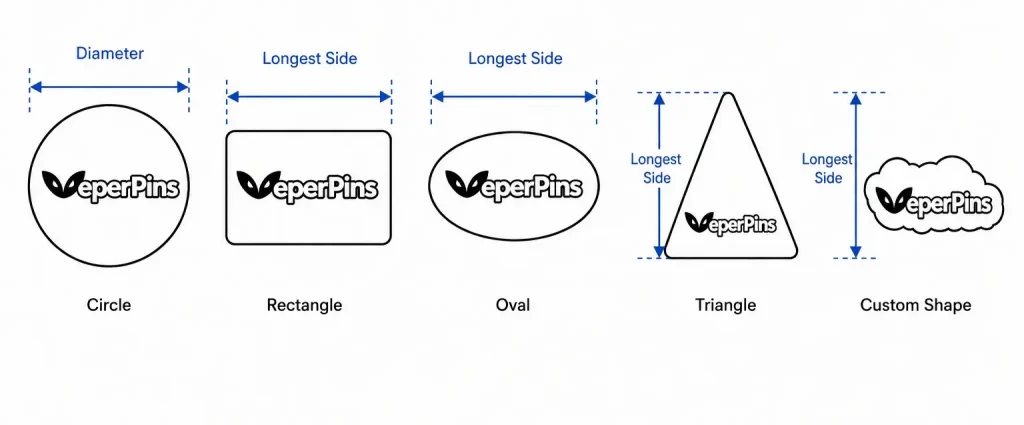
You may be wondering: lapel pins come in many different shapes, such as round, rectangular, square, oval, triangular, and even fully custom shapes. So how do you know what size you need based on the recommended size guide?
That’s a great question.
Manufacturers usually define the overall size of custom pins based on the longest side of the design, whether that is the length or the width.
Round designs are the easiest to measure—the diameter represents the overall pin size. For example, a 1-inch round pin simply means the diameter is 1 inch.
Rectangular, oval, triangular, and other custom shapes are measured differently. Instead of using both dimensions, the size is typically based on the longest side of the design.
Take a rectangular pin measuring 0.75 inch × 1.25 inches as an example—the size would usually be specified as 1.25 inches.
After the main size is confirmed, our designers will adjust the other parts of the artwork based on the overall proportions to make sure the design looks clear, attractive, and well-balanced in the final product.
Smaller Sizes Can Make Details Easier to Lose
When choosing the size for your custom lapel pins, you should consider the complexity of your artwork. Important design details may include the number of enamel colors, line thickness, design layers, logo details, and whether the design includes small icons.
If the pin size is too small, some details may not be fully presented. For example, thin lines may become less clear, smaller color areas may be difficult to fill, and some color sections may need to be simplified or combined. Therefore, if your design includes multiple colors or complex artwork, it is recommended to choose a slightly larger size to ensure the final pins look clearer and closer to the original design.
Text Size Can Affect the Final Pin Size
If your lapel pin design includes text, size selection becomes even more important. When the pin size is too small, the text area may be compressed, the letters may look crowded, and the final product may be difficult to read.
In general, short words, abbreviations, years, or simple letters work better on smaller pins. However, company names, event names, slogans, or multiple lines of text are better suited for 1.25 inches or larger. This gives the text enough space and helps keep the final pin clear and readable.
Not Sure About the Right Size? We Can Help
If you are still unsure which size is right for your lapel pin order, send us your design idea or artwork. Our team can review the details, including text size, colors, and intended use, then recommend a suitable size before production.
FAQ
Here are some common questions about lapel pin sizes.
What size lapel pin is best for suits?
The best lapel pin size for suits is usually 1–1.25 inches. This size looks professional, shows the design clearly, and is not too large for formal wear.
Does lapel pin size affect the price?
Yes. Larger lapel pins usually cost more because they require more metal, enamel, and production time. Smaller sizes are usually better for budget-friendly bulk orders.
Can custom lapel pins be made in any size?
Custom lapel pins can be made in many sizes, but not every size is practical. Very small pins may lose details, while oversized pins may feel heavy. Most projects choose 1–2 inches.