Table of Contents
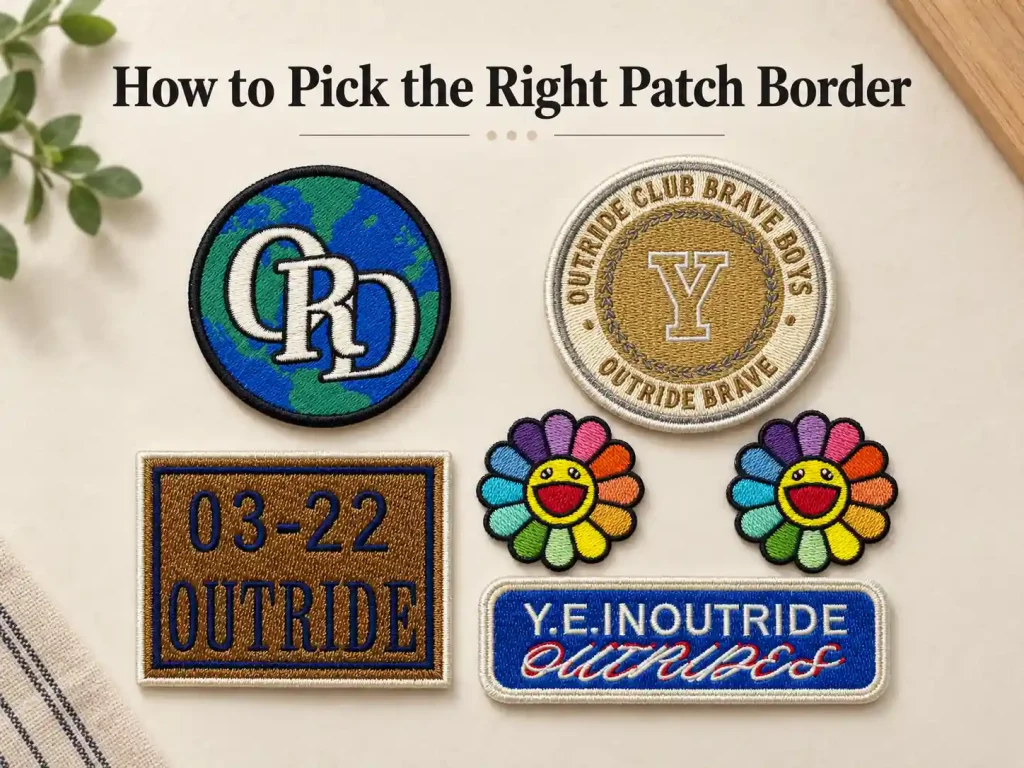
When you’re making a custom patch, there’s more to think about than the artwork, size, and backing. The edge finish matters too.
There are three common options: merrowed borders, laser-cut edges, and heat-cut edges. Simple shapes like circles and squares usually work well with a merrowed border. If the outline has a lot of curves, sharp corners, or an unusual shape, laser cutting or heat cutting is usually a better fit.
The finished look can be pretty different depending on which one you use, so let’s look at where each option works best.
Merrowed Border

A merrowed border is sewn around the outside edge to hold the fabric and stitching together. It helps prevent fraying and gives the patch a stronger finish.
You’ll usually see this style on simple shapes like circles, squares, rectangles, and ovals. The edge is thicker and slightly raised, so it has that classic embroidered patch look.
The tradeoff is that it does not always sit as flat on soft clothing or curved areas like hats and backpacks. On very small designs, the border can also take up too much space and make the artwork feel crowded.
For patches worn close to the skin, such as around a collar or cuff, the thicker edge can sometimes feel a little rough.
Laser Cut

Laser cutting works well when the outline has more detail. Sharp corners, tight curves, small cutouts, and unusual shapes are much easier to follow accurately with a laser.
As it cuts, the heat seals the fabric edge at the same time, which helps keep it from fraying. Since there is no thick stitched border around the outside, the finished edge stays thin and clean.
Polyester and nylon usually work well with this method. Very light fabrics can sometimes show a faint yellow or scorched line along the edge, and cotton is more likely to darken or become brittle if too much heat is used.
Heat Cut

Heat cutting uses a hot blade to trim away the extra fabric after the embroidery is finished. The heat seals the edge while it cuts, so there is less chance of fraying.
It gives you a thin, flat edge without the raised look of a merrowed border. For many irregular shapes, this is a simple and practical option.
The main limitation is precision. Very small corners, tight curves, or tiny cutouts are harder to control with a hot knife. If the heat or cutting speed is off, you may also see small melted spots or slightly rough areas.
Traditional hot-knife cutting can also depend more on templates or manual control, so a laser is usually the better choice when the outline gets more complicated.
The edge may feel a little firm after cutting, but the overall patch still stays fairly light and flat.
How to Choose

For simple shapes like circles, squares, and ovals, embroidered patches usually look best with a merrowed border. It gives the edge a thicker finish and holds up well over time.
Custom shapes are a little different. If the outline has a lot of curves, sharp corners, or small details, heat cutting or laser cutting usually makes more sense. A basic custom shape is often fine with a heat cut, while more detailed outlines are easier to keep clean with a laser.
Woven patches are thinner, so laser cutting is also a common choice when you want the edge to follow the design closely.
One thing that’s easy to miss is spacing around the outside. On a very small patch, a merrowed border can take up more room than you expect. For custom shapes, it’s also better to leave a little space around the edge for cutting instead of deciding on the finish after the artwork is already done.
Tell Us What You Need
Not sure whether to go with a merrowed border, heat cut, or laser cut? Send us your design, size, and how you plan to use the patch, and we can help you figure out which edge makes the most sense.
At VeperPins, we handle everything from artwork approval and production to shipping. You don’t need to know every production detail before you order—just tell us what you need, and we’ll help you from there.